
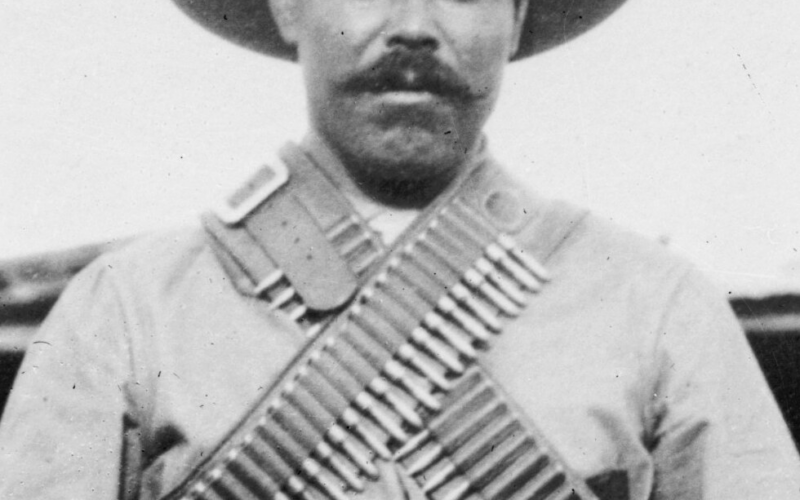
The Cinematic Revolution: Pancho Villa and the Birth of War Cinema.
The convergence of the Mexican Revolution and the nascent American film industry in 1914 represents a foundational moment in the history of film, marking the first time active warfare and commercial cinema combined to tell a story. In January of that year, during the strategic buildup for the siege of Torreón, General Francisco ‘Pancho’ Villa and the Mutual Film Corporation formalised an unprecedented contract that essentially transformed the División del Norte (Division of the North) into a part of the production. At the centre of this operation was a young Raoul Walsh, whose efforts to document the conflict under the aegis of D.W. Griffith established the grammar of the modern war film.
This collaboration was not merely a matter of reportage; it was a deliberate manipulation of events to fit within the limits of the cameras available to them at the time in order to heighten the spectacle and capture it on film. It was a time of violence and murder, exactly what Hollywood was trying to recreate in California, only here it was real and in the news.
The Mexican Revolution (1910–1920) was a familiar story in the Americas, then and now. It fundamentally reshaped the nation’s social and political structure, and made news all around the world. As with many conflicts in the continent, the focus (or blame depending on your point of view) lies with one man – Porfirio Díaz. For over thirty five years, Díaz brought modernisation and industrial growth to Mexico, but it came at a staggering human cost. Wealth was concentrated in the hands of a tiny elite and foreign investors, while the peasantry was displaced from their ancestral lands, effectively becoming debt-slaves on massive haciendas.
The revolution ignited in 1910 when Francisco I. Madero challenged Díaz’s rigged election. Madero’s call for democracy and land reform acted as a lightning rod for various regional leaders – names that film fans know even today because of the number of films made about them. In the South – Emiliano Zapata led the Ejército Libertador del Sur, fighting with the singular goal of “Tierra y Libertad” (Land and Liberty). In the North, Pancho Villa commanded the División del Norte, a highly mobile and effective paramilitary force.
After Madero successfully ousted Díaz, he was assassinated in a 1913 coup led by Victoriano Huerta. This betrayal unified the revolutionary factions against Huerta, whom they viewed as a usurper. By 1914—the year the film cameras arrived—Mexico was a patchwork of warring territories. It was a war of trains, cavalry charges, and ideology, providing a visceral, large-scale spectacle that was irresistible to the adventurous filmmakers of the north.
The man at the heart of the storm was born Doroteo Arango (1878 – 1923) in the state of Durango. According to legend, his transition from a humble sharecropper to the outlaw “Pancho Villa” occurred after he shot a landowner who had assaulted his sister. For years he lived as a bandit in the mountains, developing an intimate knowledge of the terrain and a reputation for Robin Hood-style justice.
When the revolution broke out, Villa proved to be a natural military genius. He was a teetotaler who famously loved strawberry soda and sweets, yet he was capable of chilling ruthlessness. By 1914, he was not just a general, he was a folk hero. He understood that his survival depended on American support, or at least a lack of American interference. This pragmatism led him to the Mutual Film Corporation. He was perhaps the first revolutionary to realise that the lens of a camera could be as influential as the barrel of a rifle. He was not just fighting a war, he was starring in one.

The Mutual Film Corporation, established in 1912, was one of the most significant entities of the early silent era. In operation during the transition from “short” novelties to “feature” films, Mutual was a distribution powerhouse that controlled several production subsidiaries. They were famous for their slogan, “Mutual Movies Make Time Fly,” and for their aggressive pursuit of the “star system”.
While their most famous legacy is the 1916 signing of Charlie Chaplin, their 1914 Mexican venture was their most radical experiment. They weren’t just hiring an actor; they were sponsoring a revolution. The studio provided Villa with a $25,000 advance and a share of the box office in exchange for exclusive filming rights. This agreement effectively turned the Mexican Civil War into a branded product of the Mutual Film Corporation.
The mastermind behind Mutual’s boldest moves was Harry Aitken. A quintessential early Hollywood mogul, Aitken was a man of immense ambition and little caution. He was the first to recognise that the public had an insatiable hunger for the real. He saw that the staged, theatrical films of the day were being outpaced by the drama of reality.
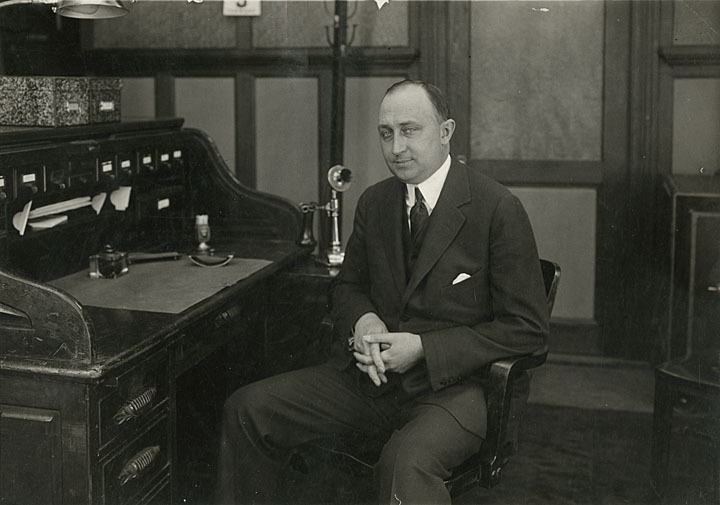
Aitken was a pioneer of the multi-reel feature and was the primary backer of D.W. Griffith. His decision to sign Pancho Villa was a calculated gamble to prove that Mutual could provide a level of “authenticity” that no other studio could match. He was a master of promotion, framing the Villa footage not as a newsreel, but as a grand, epic narrative of liberty.
To translate Aitken’s vision into reality, the studio sent a young, athletic adventurer named Raoul Walsh. Before becoming one of the most prolific directors in Hollywood history (famed for High Sierra and White Heat), Walsh was a jobbing actor and Griffith’s protege.
Walsh’s experience in Mexico was harrowing. He was tasked with capturing genuine combat while simultaneously directing Villa in staged sequences. He famously slept on the floors of troop trains and dodged federalist fire to get his shots. Walsh was a man of the “old school”—rough, physically capable, and possessed of a keen eye for drama. He even played the young version of Villa in the film’s fictionalised flashbacks. His ability to build a rapport with the General was the glue that held the production together.
The resulting production, The Life of General Villa, utilised a specific aesthetic technique that would define the look of the revolutionary general, Rembrandt lighting.
Named after the Dutch master, this technique involves placing a single, directional light source (in this case, the harsh Mexican sun) at a forty-five-degree angle to the subject. This can sometimes create a signature triangle of light on the subject’s shadowed cheek, lending the face a sense of sculptural depth and psychological gravitas.
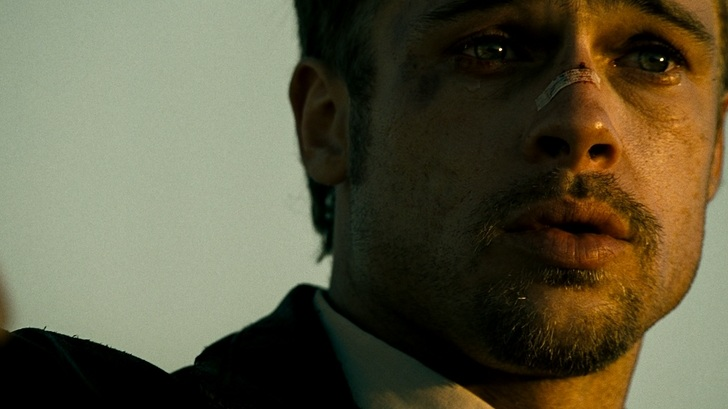
(an example of Rembrandt Lighting. Brad Pitt in David Fincher’s Seven)
Walsh and his crew used this high-contrast “chiaroscuro” effect to transform Villa from a simple insurgent into a monumental figure. Because the primitive orthochromatic film stock required immense amounts of light, the crew often had to wait for the sun to reach the perfect solar angle. This meant that the war itself was often put on hold for the sake of the image.
The most profound and controversial intersection of cinematic artifice and revolutionary violence occurred during the filming of the execution sequences. In the traditional conduct of the Mexican Civil War, executions of captured Federalists were often swift, occurring in the immediate aftermath of battle. However, Walsh’s cameras could not register movement in the low light of dusk or dawn.
Historical accounts, including Walsh’s own memoirs, describe a chilling negotiation of life and death. Pancho agreed that the condemned men were held overnight specifically so that they could be executed in the high-noon sun or at the precise moment when the “Rembrandt” shadows would lend the scene the necessary dramatic weight. Walsh, perched behind his tripod, became the director of a lethal theatre. This was the birth of the “snuff” aesthetic in a political context—where the death of the enemy was transformed into a consumable piece of propaganda and entertainment. It is a filmmaking idea that blurs the line between staged violence and actual death, creating a visceral, often voyeuristic sensation for the audience.
By delaying the executions to meet the lighting requirements, Villa effectively turned the act of killing into a choreographed performance. Unlike theatrical plays where a death occurs off-stage or is obscured by dramatic gestures, the camera remains fixed and steady. The lack of editing within the shot suggested that what the audience saw was a real representation of the end of a human life. The condemned were placed in front of adobe walls, not just for the firing squad’s efficiency, but because they provided a high-contrast background that made the physical impact of the bullets and the body’s fall to the floor visually unmistakable on the grainy nitrate film. In 1914, there were no “squibs” (explosive blood packets) or sophisticated makeup. The impact of the scene relied on the raw, jarring movements of real bodies. This lack of polish created a thrill for the audience, who knew they were witnessing something that could not be faked.
The core of the snuff aesthetic is a profound moral tension. It transforms the viewer into a passive witness to an atrocity, packaged as entertainment or historical record. In The Life of General Villa, Harry Aitken marketed these scenes as a “window into the soul of a revolution,” but for the audience in a plush New York theatre, it was a shocking yet undeniably transfixing moment.
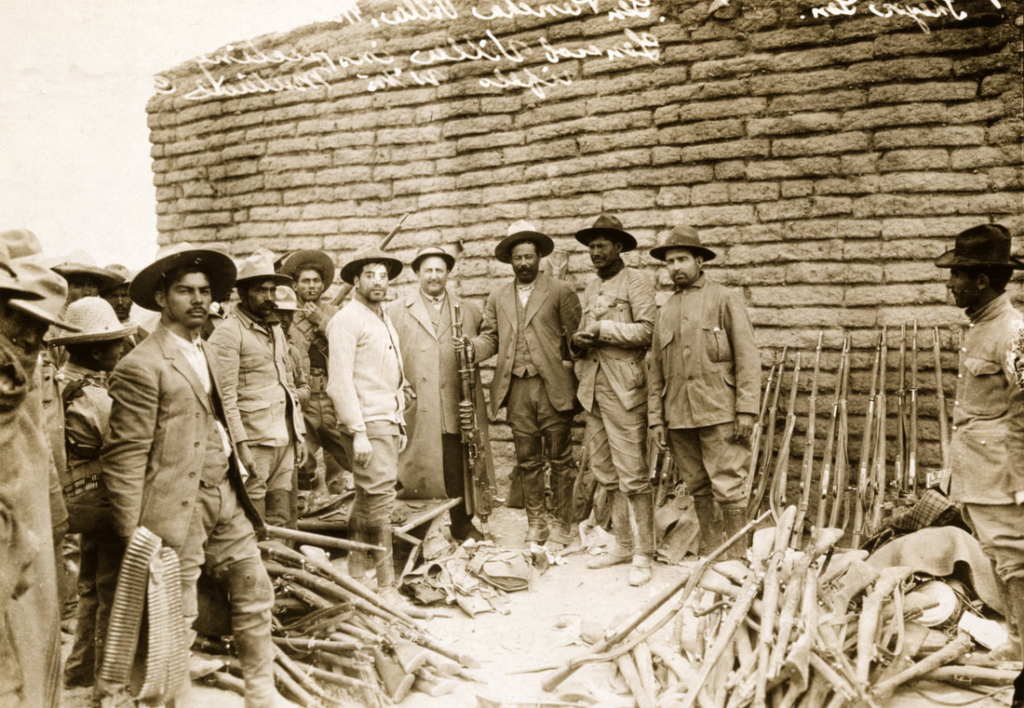
The Life of General Villa was the flagship project of the Mutual Film Corporation, and it represented a paradigm shift in how global audiences consumed war. It was not merely a film but a political and industrial event that established the template for the military-entertainment complex which is still in operation today (an example being the Tom Cruise megahit, Top Gun: Maverick in which the US Navy provided help with filming, piloting, and technical advice from Navy and Marine Corps personnel).
The film was structured as a seven-reel (approximately 1 hour and 45 minutes) biographical epic, a significant length for the era, designed to create a comprehensive mythology around the General. The narrative was divided into two distinct but interwoven halves.
The film began with a dramatic recreation of Villa’s early life, then known as Doroteo Arango. It depicted him as a peaceful sharecropper whose life was shattered when a wealthy hacendado (landowner) assaulted his sister. In this sequence, Villa is shown taking up the rifle in a justified act of vengeance, forcing him into the mountains as an outlaw. These scenes were heavily staged and starred a Raoul Walsh as the younger Villa.
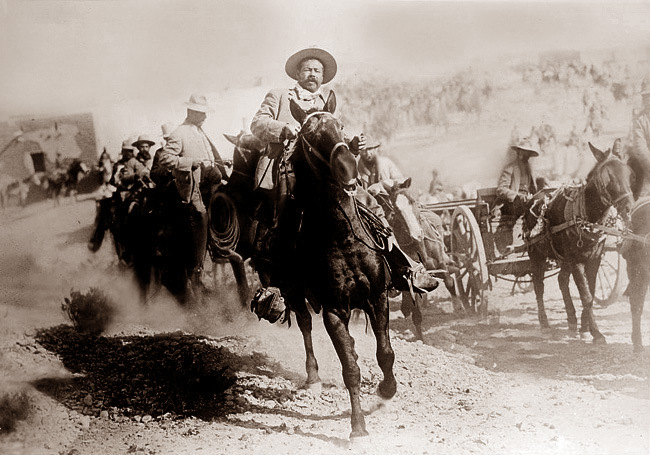
The narrative then transitioned into what was referred to as “actuality” footage, where the real Pancho Villa appeared on screen. This section followed the División del Norte through the Chihuahuan desert, showcasing the troop trains, the soldaderas (women soldiers), and the tactical brilliance of Villa’s cavalry. The climax of the film involved the Battle of Torreón, featuring genuine footage of the assault, the artillery barrages, and the subsequent occupation of the city. It concluded with Villa as the triumphant liberator, a “Robin Hood of the Sierras” who had successfully challenged a dictator.
Upon its release in May 1914, The Life of General Villa was met with a mixture of awe and morbid fascination. The American press, particularly in New York and Los Angeles, hailed it as a landmark in realism. Critics were struck by the sheer physical presence of Villa on screen, unlike the polished stage actors of the time, Villa possessed a raw, unrefined charisma that the primitive cameras captured with startling clarity.
The New York Times and other major dailies noted the “thrilling” nature of the combat footage, though some more conservative commentators expressed unease at the “bloodlust” displayed in the execution scenes. However, for the majority of the cinemagoing public, the film offered a sense of participation in a historic event that no newspaper could provide. It was perceived as a “window into the soul of a revolution” (New York Times), and Villa was briefly transformed into a star in the popular press.
While precise accounting records from 1914 are notoriously difficult to verify, historical estimates suggest that The Life of General Villa was a substantial financial success for the Mutual Film Corporation and Harry Aitken.
The film was distributed through Mutual’s extensive network of “exchanges” across North America and Europe. It played to packed houses in major cities, where ticket prices were often inflated because the film was marketed as an “educational and historical event” rather than a mere amusement.
Under the terms of the contract, Villa was paid a $25,000 advance (roughly $750,000 in today’s currency) and was promised 20% of the profits. While it is debated how much of the backend profit actually reached the General in the chaos of the revolution, the initial advance alone was enough to fund several shipments of arms and ammunition for his troops.
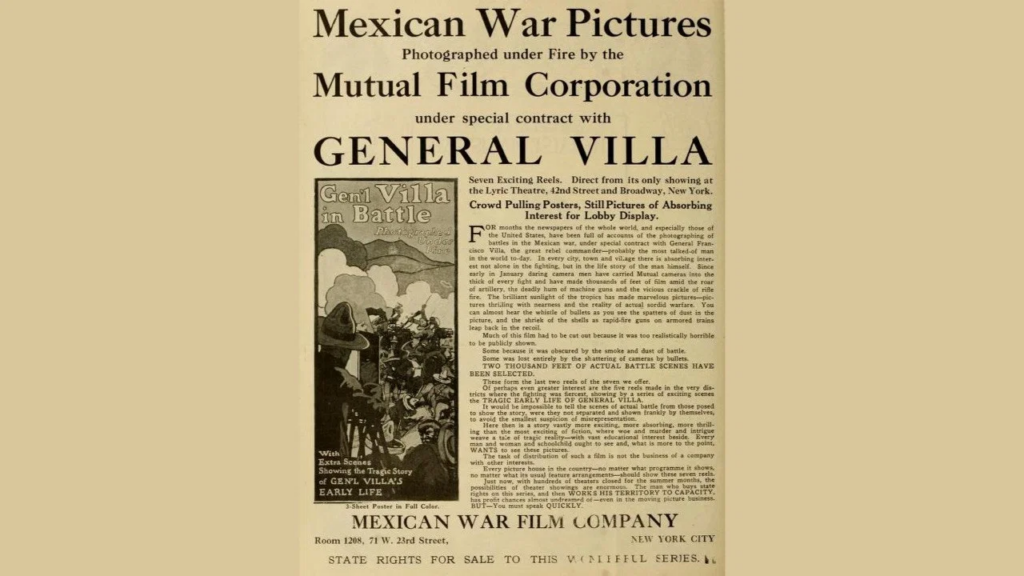
The success of the film proved to the industry that audiences were willing to sit through long, complex “feature-length” productions if the subject matter was sufficiently compelling. This success gave Harry Aitken the capital and the confidence to further back D.W. Griffith’s increasingly ambitious projects.
Though the physical film reels have been lost to the ravages of nitrate decay, the “DNA” of The Life of General Villa survives in every modern war film and documentary. Its influence can be categorised in three major ways;
Raoul Walsh’s presence on the front lines was the first instance of a filmmaker being “embedded” with a military unit for commercial purposes. It established the idea that a war is not just a political event, but a visual product. Every modern war correspondent and combat photographer follows in the footsteps of Walsh and his hand-cranked camera.
The use of Rembrandt lighting to heroise Villa proved that technical aesthetics could be used as a form of political propaganda. By controlling the shadows on Villa’s face, the filmmakers weren’t just recording a man; they were building a myth. The line between recorded truth and entertainment was blurred, and propaganda in the movies was born.
Finally, by including real executions, the film introduced a darker element to cinema, the commodification of death. It proved that audiences would pay to see “the real thing,” a psychological threshold that Hollywood has continued to explore—and exploit—ever since. The influx of Real Crime documentaries that proliferate Netflix and other streamers is evidence of this.
The Life of General Villa was the moment when the world realised that the camera was a weapon. It showed that in the 20th century, you didn’t just have to win the battle on the ground, you had to win it on the screen. The General’s horse may have carried him through the desert, but it was the Mutual Film Corporation’s lens that carried him into immortality.
In subsequent years, Pancho Villa became one of the most frequently portrayed historical figures in the history of Mexican cinema, and his presence in American Hollywood is nearly as pervasive. Beyond the foundational collaboration with Raoul Walsh, Villa’s image has evolved through various cinematic eras, shifting from a bloodthirsty bandit to a noble agrarian revolutionary, and eventually to a complex, flawed human being.
The following are the most significant examples of Pancho Villa’s portrayal in cinema, spanning a century of filmmaking.
During the 1930s and 40s, Mexico’s film industry flourished, and Villa became a central figure in the construction of a national identity.
- Let’s Go with Pancho Villa (¡Vámonos con Pancho Villa!, 1936): Directed by Fernando de Fuentes, this is widely considered one of the greatest Mexican films ever made. Unlike later hagiographies, it offers a remarkably dark and de-romanticised view of the Revolution. It follows a group of idealistic soldiers, “The Lion’s Cubs”, who join Villa only to be discarded or destroyed by the brutal reality of war. Villa is portrayed as a charismatic but ultimately indifferent force of nature.
- The Centaur of the North (El Centauro del Norte, 1951): This film, and others starring Pedro Armendáriz, established the “standard” image of Villa in the Mexican consciousness. Armendáriz, with his booming voice and physical presence, played Villa in multiple films, portraying him as a fierce, moustachioed protector of the poor—a larger-than-life hero who embodied the “macho” ideals of the time.
Hollywood’s relationship with Villa has often been fraught with the “White Saviour” trope or a fascination with the “Bandit” archetype.
- Viva Villa! (1934): Produced by MGM, this film featured Wallace Beery in the title role. It is a classic example of Hollywood’s early biographical style, high on melodrama and low on historical accuracy. Beery’s Villa is essentially a violent, buffoonish child who needs the guidance of an American journalist (played by Stuart Erwin) to understand the political weight of his actions. Despite its flaws, it was a massive hit and cemented Villa’s name in the American lexicon.
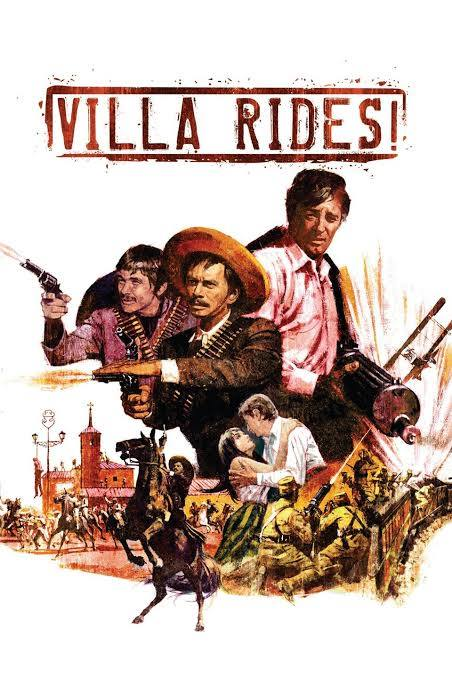
- Villa Rides (1968): This “Zapata Western” stars Yul Brynner as a bald, hairpiece-wearing Villa and Robert Mitchum as an American aviator. It reflects the cynical, action-heavy style of the late 60s. Here, the Revolution is largely a backdrop for high-octane stunts and explosions, though it does touch upon the tension between Villa’s peasant army and the professional military elites.
- Pancho Villa (1972): In a curious bit of casting, Telly Savalas (who was of Greek descent) played the General in this Spanish-American production. It is largely a standard action flick, but it highlights the persistent international fascination with Villa’s persona as a rebel who could defy the United States.
In recent decades, filmmakers have moved away from the “Robin Hood” caricature to explore the psychological and political nuances of the man.
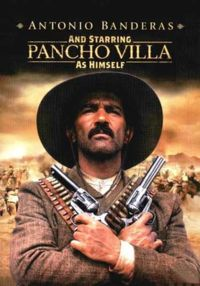
- And Starring Pancho Villa as Himself (2003): this HBO production starring Antonio Banderas is one of a handful of films about the making of a film. It explores the 1914 Mutual Film Corporation deal, focusing on the meta-narrative of how history is packaged for consumption. Banderas portrays Villa as a media-savvy tactician who is acutely aware of how he is being “framed” by the Americans.
- Zapata: A Hero’s Legend (Zapata: El sueño del héroe, 2004): While primarily about Emiliano Zapata, this big-budget Mexican production features Villa (played by Alejandro Fernández) as a contemporary ally. It uses a “magical realism” aesthetic to explore the indigenous and spiritual roots of the Revolution, moving away from the gritty realism of the 1930s.
The sheer variety of these portrayals demonstrates that “Pancho Villa” has ceased to be just a historical figure and has become a cinematic vessel. Depending on the era and the audience, he has been cast as a bloodthirsty bandit, a champion of the oppressed, a media-savvy politician, or a tragic relic of the Old West.
The Villa-Mutual contract was part of a larger zeitgeist in early 20th-century cinema that sought to exploit real-world figures for commercial gain through “reality-based spectacles.”
In 1913, William F ‘Buffalo Bill’ Cody collaborated with Essanay Studios on The Indian Wars Refought. Much like Villa, Cody sought to use the camera to solidify a waning legacy, utilising actual U.S. cavalry and Indigenous veterans to “re-enact” historical conflicts like Wounded Knee. The production was marketed as a permanent historical record, though it functioned primarily as a sanitised glorification of Cody’s persona.
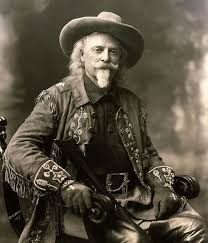
The racing driver Barney Oldfield (the first man to drive a car 60 mph) represented the industrial age’s obsession with speed. In Barney Oldfield’s Race for a Life (1913), his real-world celebrity was leveraged by Mack Sennett to ground a fictional melodrama, proving that the presence of a “real” hero was a goldmine for the burgeoning studios.
While The Life of General Villa is now a lost film—its nitrate reels likely consumed by fire or decay—its influence is indelible. The collaboration established the precedent for film as a weapon of psychological warfare. Pancho Villa’s relationship with Hollywood eventually disintegrated following his 1916 raid on Columbus, New Mexico, which transformed him from a cinematic hero back into a national security threat. Nevertheless, the 1914 production proved that the camera possessed the power to reshape history. Through the technical innovations of Walsh, the industrial ambition of Aitken, and the formal brilliance of Griffith, the Mexican Revolution became the first major conflict to be edited, lit, and packaged for a global audience, signifying the birth of the modern media age.