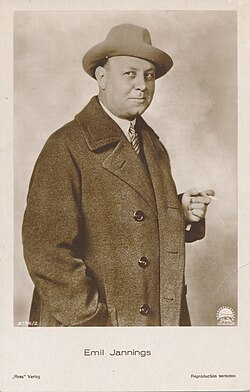
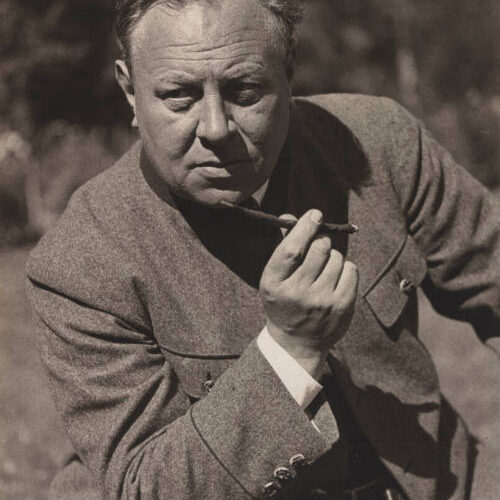
Emil Jannings; from Hollywood to Hitler.
There have been many great actors on the silver screen, men and women who could shred their entire personality and take on new ones so convincingly that we forget that we are watching a performance. Throughout film history, many have been recognised by the Academy of Motion Picture Arts and Sciences with their legacy preserved forever. Except, possibly, for the first Oscar winner for best actor, whose career took a turn from brilliance and art, to propaganda and ignominy.
Emil Jannings was one of the undisputed Kings of the Screen. He was a man of immense physical presence—a hulking, expressive force of nature who could convey the total collapse of a soul with nothing more than the slump of his shoulders or the twitch of a heavy eyelid. Yet his legacy is one of the most fractured in art. It is a story framed by two starkly different moments, seventeen years apart, that serve as bookends to an entirely self imposed career destruction. The first occurred on the 16th May, 1929, when he became the first person ever to win an Academy Award for Best Actor. The second occurred in 1945, when he stood in the ruins of a defeated Germany, clutching that same golden statue as a literal shield against the advancing Allied tide.
His journey from the pinnacle of Hollywood respectability to the depths of Nazi collaboration is more than just a biography; it is a cautionary tale about the vanity of the artist and the fragility of a legacy when it is built on the shifting sands of political opportunism.
Emil Jannings was born Theodor Friedrich Emil Janenz in Switzerland in 1884, but his soul was forged in the theatre of Germany. He was a product of the Max Reinhardt (the man credited with introducing Expressionism to Theatre and, later, cinema, with his play Der Bettler) school of acting, a tradition that emphasized a profound, almost primal physicality. In the silent era, where the voice could not assist the performer, Jannings’ body became a finely tuned instrument of tragedy.
During the 1920s, the Weimar Republic was the creative heart of the world. While Hollywood was perfecting the slapstick comedy and the Western, German Expressionism was exploring the darker recesses of the human psyche. Jannings was the crown jewel of UFA (Universum Film AG – Metropolis (1927) and Woman in the Moon (1929), The Blue Angel (1930)), the great German studio. He didn’t just play characters, he inhabited types that felt ancient and archetypal.
He specialized in the “Great Fall”—the narrative of a powerful or proud man brought low by lust, pride, or simple, cruel circumstance. In F.W. Murnau’s The Last Laugh (1924), Jannings played a hotel doorman whose entire identity is wrapped up in his ornate, gold-buttoned uniform. When he is demoted to a washroom attendant due to his age, the transformation is visceral. Jannings doesn’t just act sad, his very frame seems to shrink. His shoulders, once broad enough to hold up the revolving doors of the Atlantic Hotel, collapse inward. Without a single line of dialogue, Jannings showed the world what it meant to lose one’s dignity. Indeed, in the entire film, there is only one title card. It is often cited as one of the greatest examples of ‘pure cinema’.
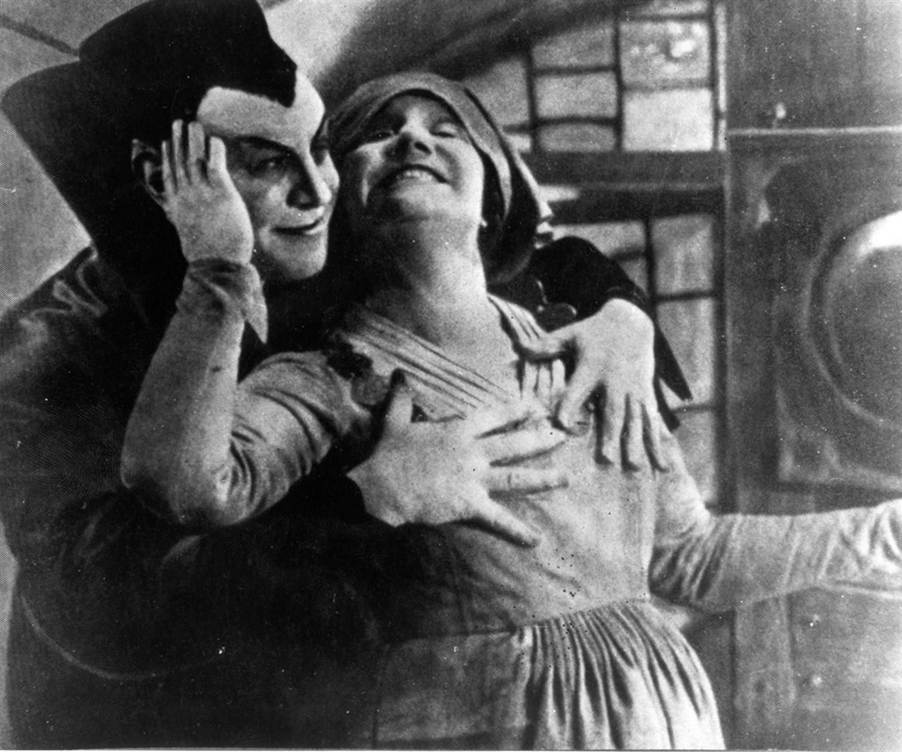
It was this performance that alerted Hollywood to his genius. He followed it with Faust (F.W. Murnau, 1926), where he played a mischievous, terrifying Mephisto, and Variety (E.A. Dupont, 1925), where he played a trapeze artist driven to murder by jealousy. By the mid-1920s, Jannings was more than a German star, he was a global phenomenon.
When Paramount Pictures lured Jannings to America in 1927, it was treated as a state visit. Hollywood was still a young industry, often looked down upon by European intellectuals as a factory for low-brow entertainment. Bringing Jannings to California was a move to buy “prestige.”
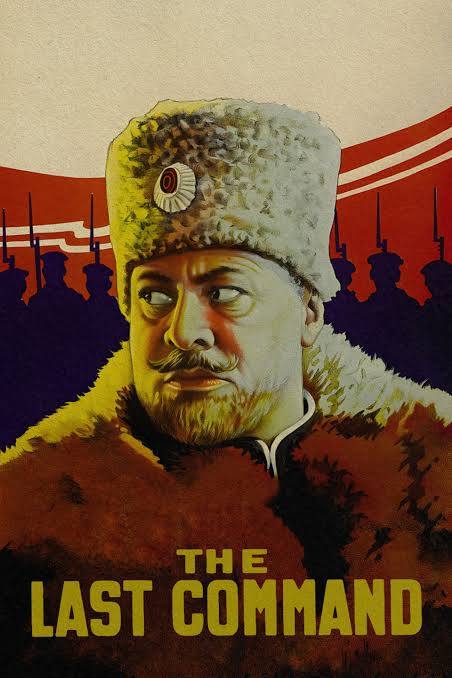
Jannings’ American debut came in The Way of All Flesh (Victor Fleming, 1927), followed by The Last Command (1928), directed by Josef von Sternberg. In the latter, Jannings played a Russian Grand Duke who, after the Bolshevik Revolution, ends up as a pathetic film extra in Hollywood, forced to play a version of his former self.
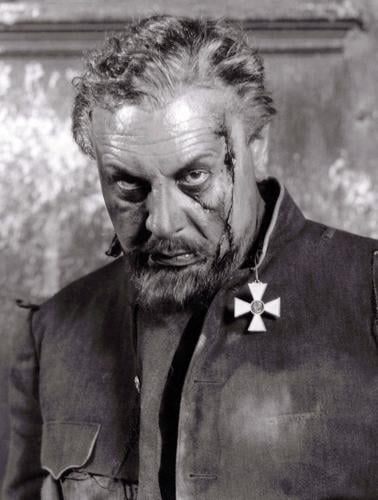
Criterion.com describes the film as:
There is irony (and a touch of sadism) in the fact that the young von Sternberg has cast Germany’s biggest star in the role of a Hollywood bit player. And the story features the further irony that this Hollywood extra is, in fact (or rather, in fiction!), a deposed tsarist general who now has to play a version of his former self. This elusive and maddening intertwining of life and fiction that acting requires lies at the core of von Sternberg’s film.
On a side note, the director of the film-within-a-film is William Powell, who would go on and star in The Thin Man series with Myrna Loy, and My Man Godfrey.
In May 1929, the newly formed Academy of Motion Picture Arts and Sciences held its first awards ceremony at the Hollywood Roosevelt Hotel. It was a modest affair compared to the televised spectacles of today (it is the only Oscars Ceremony not to be broadcast on Radio or Television), but the stakes were high for the industry’s image and for Louie B. Meyer’s vision of Union beating inhouse arbitration (see my article: The origin of the Academy Awards and the control of an industry). Jannings was named the winner of the very first Best Actor Oscar for his work in both The Way of All Flesh and The Last Command.
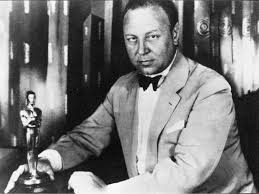
However, Jannings wasn’t there to receive it. The “talkies” had arrived. The success of The Jazz Singer in 1927 had signalled the end of the silent era, and Jannings, with his thick, guttural Swiss-German accent, knew his days in Hollywood were numbered. He was an actor of the body, not the voice.
Before he boarded a ship back to Europe, the Academy handed him the gold statuette. A famous publicity photograph from this era shows Jannings, looking every bit the triumphant titan, clutching the Oscar. He was the first man to be officially recognized by the industry as “the best.” Writing in the Los Angeles Times, critic Edwin Schallert called him “the king of the European film stars,” noting that his departure marked the “close of a picturesque phase” of history. He left Hollywood as a legend, carrying a piece of American gold that he believed cemented his status as a global immortal.
When Jannings returned to Germany, he found a country in the midst of a violent political fever. The Weimar Republic was dying, and the Nazi Party, led by Adolf Hitler and his propaganda chief Joseph Goebbels, was on the rise.
As the Nazis seized power in 1933, the German film industry underwent a radical “cleansing.” Jewish directors, writers, and actors—the very people who had helped build UFA and Jannings’ career—were purged. Many fled to Hollywood, including Marlene Dietrich, Billy Wilder, and Fritz Lang.
Jannings faced a choice. He was a wealthy man with an international reputation. He could have easily moved to Switzerland, London, or returned to a character-actor role in Hollywood. Instead, he chose to stay.
It is often debated whether Jannings was a “true believer” in Nazi ideology or simply a man of monumental vanity who couldn’t bear to leave the spotlight. Joseph Goebbels, a failed playwright who worshipped celebrity, knew that Jannings was his greatest asset. He didn’t just want actors; he wanted icons. He named Jannings a “Staatsschauspieler” (State Actor) and eventually appointed him to the board of UFA.
In the end, Jannings’ decision to stay wasn’t just a passive act of residence; it was an active commitment to the regime’s cultural vision. He became the face of Nazi cinematic “prestige.” While other actors made light comedies or “mountain films” to distract the public, Jannings was tasked with the heavy lifting: the “historical” dramas that would justify the Third Reich’s worldview through the lens of the “Great Man” theory.
During the 1930s and early 1940s, Jannings starred in a series of films that were masterpieces of manipulation. He used the same tragic weight and physical gravitas that had won him an Oscar to sell the ideology of hate and authoritarianism.
Der Herrscher (The Ruler, 1937)
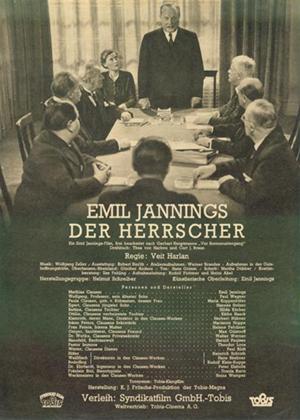
In this film, directed by Veit Harlan (who would later direct the virulently anti-Semitic Jud Süß, 1940), Jannings plays Matthias Clausen, a powerful industrialist. When his greedy children try to declare him insane to seize his wealth, Clausen fights back, eventually leaving his entire empire to the State.
The film is a direct cinematic translation of the Führerprinzip (the Leader Principle). It argues that the “Great Man” is above the law and the family, and that the individual’s only true purpose is to serve the national interest. Jannings’ performance was designed to make the German public equate industrial leadership with Hitler’s political leadership.
Ohm Krüger (Uncle Krüger, 1941)
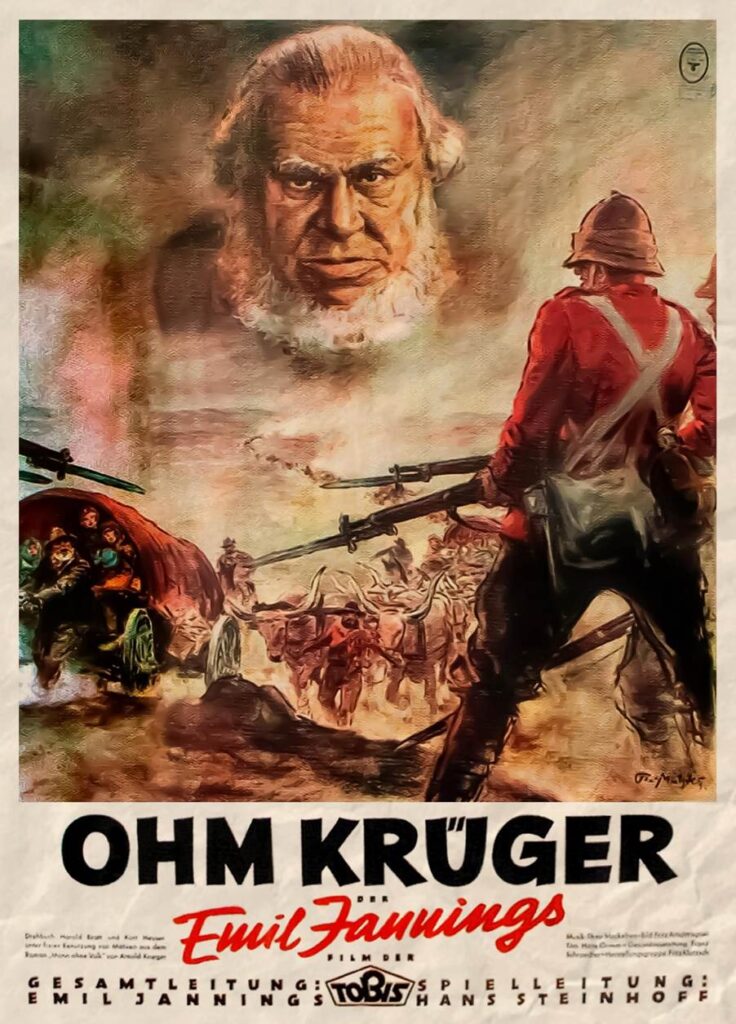
This remains the darkest stain on Jannings’ filmography. A massive, big-budget “anti-British” epic set during the Boer War, it featured Jannings as the Boer leader Paul Krüger. The film depicted the British as sadistic monsters who invented concentration camps to torture Boer women and children. The irony, of course, was staggering, as the Nazis were operating their own death camps at that very moment. Jannings was the driving force behind the film, even serving as an uncredited producer. Goebbels was so enamoured with the result that he named it the “Film of the Nation.” Jannings had successfully transformed his image from a universal tragic hero into a nationalist martyr.
Die Entlassung (The Dismissal, 1942)
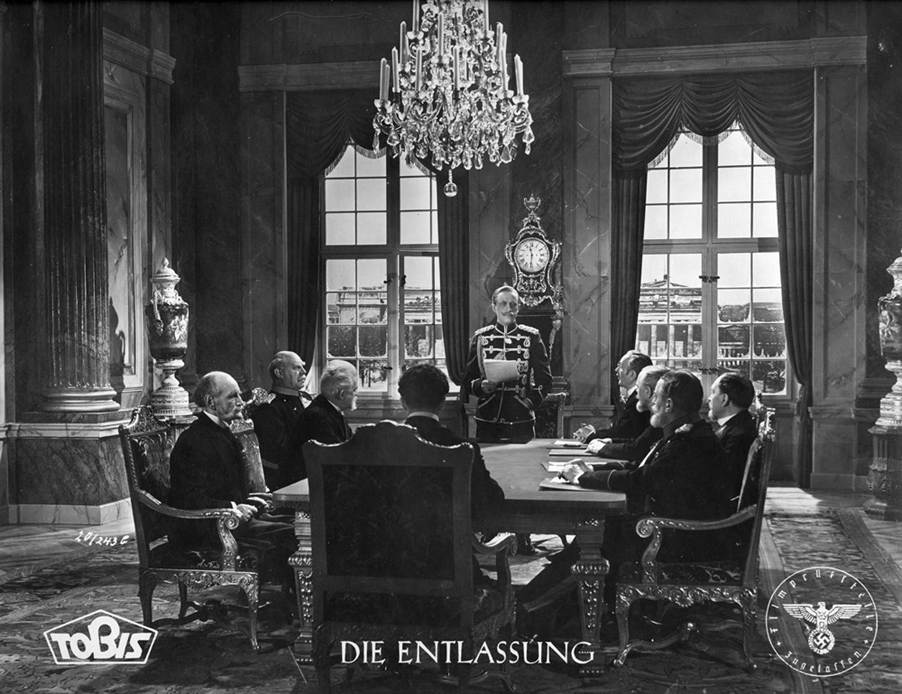
Jannings took on the role of Otto von Bismarck, the man who unified Germany. The film focused on Bismarck’s clash with the young, incompetent Kaiser Wilhelm II. The subtext was clear to any German viewer; Germany needs a strong, singular elder statesman to guide it. By portraying Bismarck as a misunderstood visionary being hindered by smaller men, Jannings was providing a historical justification for Hitler’s absolute rule.
By 1942, Jannings was more than an actor; he was a pillar of the state. He was wealthy, decorated, and untouchable. He believed his artistic genius gave him a moral “pass.” He famously told friends that he was “saving the German art of acting” by staying, a delusion that allowed him to ignore the screams coming from the east.
The climax of the Jannings tragedy—the moment that forever altered how history would view him—occurred in the spring of 1945. The “Thousand-Year Reich” was a smoking ruin. Berlin was being squeezed between the Soviet steamroller from the East and the American and British forces from the West.
Jannings had retreated to his villa in the countryside, away from the worst of the bombing. The man who had portrayed the “Ruler” and the “Iron Chancellor” was now a terrified old man watching his world vanish.
As American troops moved into his area, the State Artist found himself facing the very people his films had spent a decade mocking. He had portrayed Americans as “plutocratic” and “uncultured,” and the British as “war criminals.” Now, those “uncultured” soldiers were at his front door.
According to various historical accounts—most notably recorded by the soldiers who were there—Jannings did not meet the end with the dignity of his silent film characters. Instead, he emerged from the shadows of his home clutching his 1929 Oscar statuette. As the GIs approached, guns drawn, the world’s first Best Actor ran toward them, waving the gold figure in the air like a white flag. He began shouting in broken, desperate English:
“Don’t shoot! I have won an Oscar! I am Emil Jannings! I have won an Oscar!”
It was a scene of total moral bankruptcy. In the face of the ultimate consequence for the regime he supported, Jannings didn’t appeal to his humanity, his State Artist status, or his German heritage. He appealed to his status as a Hollywood celebrity. He used an American award—a symbol of the “decadent” West—as a literal shield to protect himself from the soldiers of that same West.
He reportedly pulled out his Academy diploma, showing it to the bewildered GIs as if it were a diplomatic passport. To the soldiers, he was just another collaborator trying to save his skin, but to the history of cinema, he was a man admitting that his entire “heroic” German persona was a mask – for the great actor, everything was an act. The only thing of value he truly possessed was the recognition given to him by the “enemy” in 1929.
The Allies were not moved by the gold statue. Following the war, Jannings was subjected to the “denazification” process. While he wasn’t executed or imprisoned like the high-ranking political leaders, he was permanently blacklisted. The man who had been the king of two continents found that he had no stage left to stand on.
He retreated to his villa at Lake Wolfgang in Austria. He spent his final years writing memoirs that were largely seen as a desperate attempt to rewrite his own history. He claimed he was a “victim of circumstances,” that he was “forced” to make propaganda, and that his heart was always with the art, never the Party.”
But the world had moved on. The “talkies” he had feared had become the standard, and a new generation of actors like Marlon Brando, James Dean or Montgomery Clift, were bringing a different kind of realism to the screen—one that didn’t require the grand, theatrical gestures of the silent era. Jannings was a relic of a dead medium and a disgraced regime.
Even his physical legacy began to disappear. The Way of All Flesh, one of the films that earned him that first Oscar, is now a “lost film.” No complete copies are known to exist. It is a haunting metaphor, the proof of one of his greatest artistic achievements has been erased by time, leaving only the record of his political shame. Even those films that do exist, some of which are true masterpieces even today, are tainted by the shame of his Naziism.
Emil Jannings died of liver cancer in 1950 at the age of 65. He died alone, culturally isolated, apparently clutching his Oscar until the very end. His life asks a question that people have been asking from the dawn of cinema, Can We Separate the Art from the Artist?
On one hand, his contributions to film technique are undeniable. He pioneered the “psychological” style of acting that would arguably eventually lead to the Method. Without Jannings, we might not have the intense, internal performances of actors like Robert De Niro or Daniel Day-Lewis. He taught the camera how to look into a man’s soul.
On the other hand, Jannings is the ultimate example of how high art can be co-opted by evil. He proved that an actor can understand human emotion perfectly on screen while remaining completely indifferent to human suffering in reality.
Jannings would argue that his talent made him above politics. He believed that as long as he was acting well, it didn’t matter what the script was saying. History proved him wrong. When an actor becomes the face of a nation, they inherit the nation’s sins. Jannings chose to be the face of Nazi Germany and he cannot complain when history treats him as such.
Being the “First Oscar Winner” should have guaranteed him a place in the pantheon of heroes. Instead, it became a punchline to his own tragedy—the gold statuette he waved at soldiers in 1945 is the only reason many people remember his name today.
When we look back at that first Academy Awards ceremony in 1929, we see a moment of pure artistic potential. Cinema was the new language of the world, and Emil Jannings was one of its first poets.
Emil Jannings began his career playing men who lost their dignity—the doorman, the grand duke, the fallen circus performer. In a cruel twist of fate, he ended his life by becoming his own most tragic character. He was the man who had the world at his feet and a golden statue in his hand, and he traded it all for a front-row seat to an apocalypse.
The tragedy of Emil Jannings isn’t that he was a bad actor; it’s that he was a great one who used his gift to tell the most dangerous lies of the 20th century. And in the end, not even an Oscar could save him from the truth.